

GeekAcademy is an advanced free AI course for developers, and it is a part of Microsoft & Geektime's national initia tive to empower Israel’s developer community. This course focuses on Agentic AI, helping developers master tools like GitHub Copilot, Azure AI Foundry, and Microsoft Fabric to build, orchestrate, and deploy autonomous agents. Participants will move from code to production through a unified real-world project, exploring RAG, MCP, and GenAIOps, guided by Microsoft and GitHub experts.


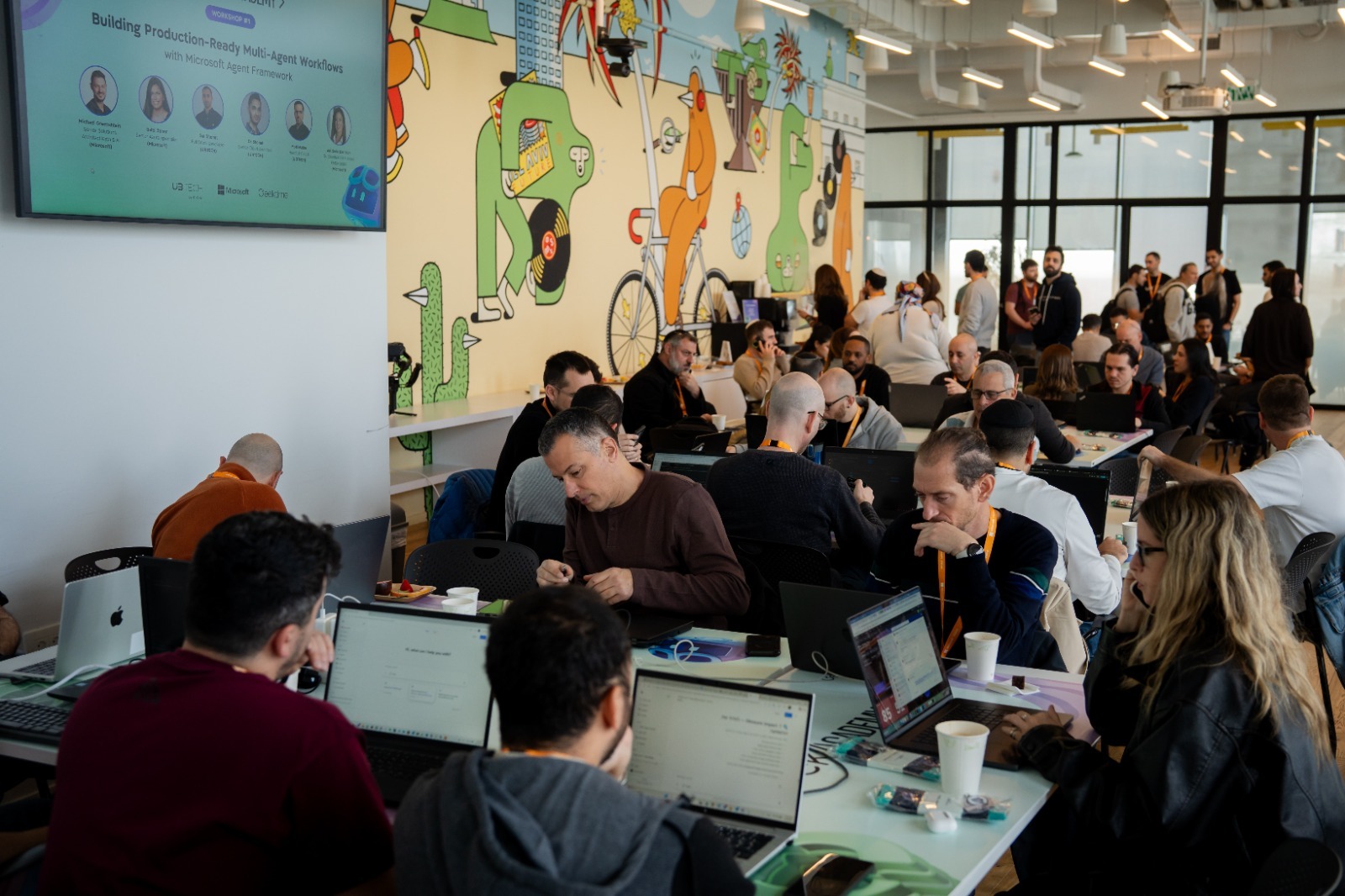


< Course Syllabus >

 GeekAcademy is designed for developers with at least 3 years of experience and a basic understanding of cloud and Python.
Our syllabus includes 15 online sessions and 3 in-person workshops.
Online sessions are open to all students, while the in-person workshops require additional registration and must be approved in advance by email.
All online sessions include an expert hour provided by Microsoft and its partners.

GitHub Copilot as an AI Agent in the Software Development Workflow
📅January 27th 🕒10:00-11:15 💻 Online Webinar
Coding with agents is rapidly becoming a first-class workflow. Discover how GitHub Copilot has evolved into a true AI agent embedded throughout the software development lifecycle, enabling intelligent automation at every phase—from planning and coding to testing, reviewing, and deployment. In this session, you’ll learn how to harness the latest Copilot capabilities in GitHub.com and inside Visual Studio Code to streamline complex tasks and accelerate your development process.
Learning Outcomes:
👨🏻💻Learn about GitHub Copilot’s most advanced features and how they enable agentic, AI-driven development workflows.
👩🏻💻Understand how GitHub Copilot operates as an AI agent across every phase of the SDLC, providing contextual awareness from planning to deployment.
👨🏻💻Apply Copilot’s newest capabilities in Visual Studio Code to automate complex tasks.
🕒11:15-12:30 🎓Expert Hour
Q&A Session with Yuval Avidani


Agentic Debugging with GitHub Copilot in Visual Studio & VS Code
📅February 3rd 🕒10:00-11:15 💻 Online Webinar
In this session, we’ll explore how GitHub Copilot can be used as an agentic debugging partner inside your IDE.
You’ll see how to leverage GitHub Copilot to investigate runtime errors, understand failing code paths, analyze logs and exceptions, and iteratively fix issues through prompts and the different GHCP tools.
We’ll show how GH Copilot goes beyond code completion — helping developers reason about problems, suggest fixes, refactor code safely, and improve the overall debugging experience.
Learning Outcomes:
👨🏻💻Use GitHub Copilot to debug application issues directly within your IDE.
👩🏻💻Investigate errors, logs, and unexpected behavior using natural language prompts.
👨🏻💻Adopt practical Copilot debugging patterns that can be applied in real-world projects.
🕒11:15-12:30 🎓Expert Hour
Q&A Session with Avihai Hajaj


Real-World Code Migration with GitHub Copilot Agent Mode
📅February 10th 🕒10:00-11:15 💻 Online Webinar
This session will focus on using GitHub Copilot to explore, plan, and execute large-scale code refactoring within VS Code
In the practical phase, we’ll work with Copilot Agent Mode and Copilot Agents to perform migrations of significant code bases - from .NET to .NET Core, and from older to newer Python versions.
Learning Outcomes:
👩🏻💻 Understand how to use GitHub Copilot within VS Code to explore, plan, and execute large-scale code refactoring.
👨🏻💻 Gain hands-on experience with Copilot Agent Mode and Copilot Agents for migrating large codebases, including .NET to .NET Core and Python version upgrades.
👩🏻💻 Learn best practices for managing and validating complex code migrations using AI-assisted development workflows.
🕒11:15-12:30 🎓Expert Hour
Q&A Session with Aviad Fenigstein


Build and Launch AI Agents Fast with Azure AI Foundry and the Microsoft Agent Framework
📅February 17th 🕒10:00-11:15 💻 Online Webinar
You will learn how to build reliable AI agents using Azure AI Foundry and the Microsoft Agent Framework. The session walks through the full workflow, from grounding and tool setup to routing and evaluation. You will see how the framework manages plans, calls tools, handles state, and keeps agent output predictable. You will deploy an end to end agent, connect it to real data, and test its performance in Azure AI Foundry. The goal is to give you a fast and practical path to ship production agents.
Learning Outcomes:
👨🏻💻Understand the core concepts of the Microsoft Agent Framework.
👩🏻💻Learn how to define tools, plans, and routing logic for stable agent behavior.
👨🏻💻Use Azure AI Foundry to manage, test, and monitor agents at scale.
👩🏻💻Build and deploy a working agent that interacts with real systems.
👨🏻💻Speed your delivery of agent based solutions in enterprise environments.
🕒11:15-12:30 🎓Expert Hour
Q&A Session with TBD


Hands-On Workshop #1 - Building Production-Ready Multi-Agent workflows with Microsoft Agent Framework
📅February 23rd 🕒09:00-16:00 🤝 Physical Event @ Microsoft Reactor IsraelAI is moving beyond prompts into the era of agents
Instead of models that only respond, we are now building systems that reason, act, use tools, and collaborate.
In this hands-on workshop, we will build a real Copilot-style system using the Microsoft Agent Framework (Python SDK) - progressing from a single agent to production-minded multi-agent workflows.
Learning Outcomes:
👨🏻💻 Building your first agent using the ReAct pattern.
👩🏻💻 Working with tools and threads.
👨🏻💻 Memory and state management.
👩🏻💻 Human-in-the-loop approvals.
👨🏻💻 Workflow orchestration (sequential, parallel, branching)
👩🏻💻 Multi-agent collaboration.
👨🏻💻 Production considerations: guardrails, reliability, observability.


Advanced RAG Practices with Azure AI Search and Microsoft Foundry
📅February 24th 🕒10:00-11:15 💻 Online Webinar
Learn how to take RAG to the next level with performance tuning, query augmentation, agentic retrieval, and GraphRAG—powerful methods to boost precision and depth in AI-driven applications.
Learning Outcomes:
👨🏻💻Learn about RAG best practices
👩🏻💻Learn about advanced RAG features: agentic retrieval, GraphRAG
👨🏻💻Deep dive into real-world scenarios
🕒11:15-12:30 🎓Expert Hour
Q&A Session with Dor Getter


Build and launch AI agents fast with Microsoft Foundry and the AI Toolkit
📅March 10th 🕒10:00-11:15 💻 Online Webinar
Build and ship AI agents fast with Microsoft Foundry Models and Azure. Prototype with open models, scale with Foundry models, and streamline workflows using the AI Toolkit in VS Code. Experiment with models and prompts, evaluate agent responses, then move from prototype to cloud with cutting-edge developer tools.
Learning Outcomes:
👨🏻💻Explore and compare models with the AI Toolkit Playground; iterate over prompts using the Agent Builder and evaluate results on a test dataset.
👩🏻💻Move from prototype to code, combining your models and prompts with your app code with Visual Studio Code and Microsoft Foundry.
👨🏻💻Go smoothly into production by leveraging pre-built enterprise-ready features of Microsoft Foundry to deploy, safeguard and monitor your AI agent over time.
🕒11:15-12:30 🎓Expert Hour
Q&A Session with Uri Menuchin


Agentic AI patterns & Unlock Your Agent’s Potential with Model Context Protocol
📅March 17th 🕒10:00-11:15 💻 Online Webinar
In this session, we’re going to have two practical conversations:
Graduate from single agents to full multi-agent systems. We’ll explore eight patterns that power production AI: chain agents that work like an assembly line, fan-out for parallel expert opinions, loops that run until a critic approves, and routing requests to the right specialist. Then we’ll unlock Supervisor agents that delegate like project managers, and Human-in-the-Loop gates for cases where humans need the final say. Finally, we’ll explore goal-oriented planners that find optimal paths and peer-to-peer meshes where agents collaborate as equals without a central boss.
Build a conversational AI agent for Zava, a retail DIY company, that analyzes sales data and helps customers find products. Learn how to create secure, intelligent agents using Microsoft Foundry Agent Service, the Model Context Protocol (MCP) for external data connections, and PostgreSQL with Row Level Security (RLS) and pgvector for role-based data protection and semantic search.
Learning Outcomes:
👨🏻💻Explore 8 production AI patterns: Master frameworks like chain agents, fan-out, and routing.
👩🏻💻Implement advanced control mechanisms: Utilize Supervisor agents, Human-in-the-Loop, and goal-oriented planners.
👨🏻💻Build a conversational AI agent: Develop a practical retail solution for analyzing sales data.
👩🏻💻Secure your AI infrastructure: Learn to use Microsoft Foundry, MCP, and PostgreSQL RLS.
🕒11:15-12:30 🎓Expert Hour
Q&A Session with Aviad Fenigstein

Shipping AI with Confidence: LLM Testing and Evaluation with Azure AI Foundry
📅March 24th 🕒10:00-11:15 💻 Online Webinar
Embedding strong evaluation practices into solutions built with Azure AI Foundry is essential for delivering accurate, reliable results. This session covers practical approaches to designing systems that continuously measure and improve quality. You’ll learn how to stay resilient through prompt changes, LLM upgrades, and evolving business needs.
Learning Outcomes:
👨🏻💻Learn about AIOps practices
👩🏻💻Learn about Microsoft Foundry Evaluation
👨🏻💻Deep dive into code examples and real-world scenarios
🕒11:15-12:30 🎓Expert Hour
Q&A Session with Ido Garbi


From Builder to Ruler: Spec‑Driven AI Engineering
📅April 13th 🕒10:00-11:15 💻 Online Webinar
Move beyond vibe coding to Spec‑Driven AI Engineering. We’ll talk about the physics of software - resilience, observability, and security- and how to meet these constraints with AI agents. You’ll see how clear specifications and instructions, tools connected through MCP, together with strong guardrails guide coding agents to production‑grade results. We’ll share best practices for “ruling” agents when building real code, and cover the Microsoft Agent Framework to show how to build your own agents, tools, and MCP integrations, not just consume them.
Learning outcomes:
👩🏻💻 Master Spec-Driven development for building reliable production code with coding agents
👨🏻💻 Understand the limits of AI agents and how to control them
👩🏻💻 Understand how Microsoft Agent Framework supports building custom agents and MCP tools
AI Squads - Working with teams of agents - How I Run Multiple Autonomous Squads from My Terminal
👤 Tamir Dresher, Principal Engineer {Microsoft}
What happens when you give AI agents real autonomy — not just code completion, but full team coordination, cross-repo work, and 24/7 monitoring? In this session, I'll share how I built and operate multiple autonomous AI squads that write code, submit PRs, publish content, run research, and monitor themselves — all orchestrated from a CLI. We'll see real demos of agents working in parallel across repos, making decisions, and shipping production code while I sleep.
Learning outcomes:
👩🏻💻 From Copilot to Squad - the leap from code completion to autonomous agent teams
👨🏻💻 Team casting, charters, and routing - how agents know what to do
👩🏻💻 Ralph - the always-on work monitor that keeps the pipeline moving
👩🏻💻 Multi-machine parallelism - agents working across repos and worktrees simultaneously
👨🏻💻 Real results: 170 tests, 6 PRs, 30 articles, 2 games - built in one weekend
👩🏻💻 Cross-squad orchestration - research institute, game company, and content empire working together
👨🏻💻 Live demo: giving a task and watching agents fan out in real time

Hands-On Workshop #2 - Building Agentic Systems with a Spec-Driven Approach
📅April 15th 🕒09:30-15:00 🤝 Physical Event @ Microsoft Reactor Israel
Shift from generative to agentic. In this advanced, hands-on workshop, you will apply Spec-Driven AI Engineering end-to-end: install and use Spec Kit, set up practical agent guidance, build an agentic app from spec using Microsoft Agent Framework, then develop a new MCP and plug it into your app.
Attendance note: Apr 13th "From Builder to Ruler: Spec‑Driven AI Engineering" participation is required for this workshop.
Learning Outcomes:
• 👩🏻💻 Apply Spec-Driven AI Engineering (and Spec Kit) to define intent and guide implementation.
• 👨🏻💻 Set up effective agent guidance in a real repo (agents.md, skills, workspace conventions).
• 👩🏻💻 Build an agentic app from spec using Microsoft Agent Framework.
• 👨🏻💻 Develop a new MCP and integrate it into your app’s end-to-end agent flow.




AI‑Powered Infrastructure Management - Terraform, GitHub Copilot, and Azure AI Foundry Agents
📅April 20th 🕒10:00-11:15 💻 Online Webinar
In this session, you will learn how to leverage GitHub Copilot and Azure AI Foundry Agents to design, generate, and manage Infrastructure as Code using Terraform. We will practice writing effective system prompts, applying MCP for Azure‑aligned best practices, and using Copilot to build robust, scalable Terraform configurations that meet real‑world enterprise standards.
Learning Outcomes:
👨🏻💻Use GitHub Copilot to generate secure, high‑quality Terraform for Azure.
👩🏻💻Build effective task‑driven Agents in Azure AI Foundry using strong system prompts.
👨🏻💻Apply an end‑to‑end IaC workflow.
🕒11:15-12:30 🎓Expert Hour
Q&A Session with Avihai Hajaj

Discovering Unknown Unknowns with AI and Real-Time Intelligence
📅April 28th 🕒10:00-11:15 💻 Online Webinar
Discover how Microsoft Fabric empowers organizations to stay competitive in a fast-paced world through Real-Time Intelligence. In this session, we will explore how to leverage AI and the latest tools in Real-Time Intelligence to extract actionable insights from streaming data.
We’ll dive into practical techniques for setting up robust real-time data pipelines to power your AI applications and talk about the latest releases and future roadmap for AI features in Real-Time Intelligence. Join us to learn how to transform raw streams into high-impact intelligence, uncovering the "unknown unknowns" that drive enterprise innovation.
Learning Outcomes:
👨🏻💻Master practical techniques for building robust real-time data pipelines.
👩🏻💻Leverage AI tools to extract actionable insights from continuous streaming data.
👨🏻💻Explore the latest releases and the future roadmap for AI features in Real-Time Intelligence.
🕒11:15-12:30 🎓Expert Hour
Q&A Session with Sean Goaz


Securing AI Agents with Microsoft Defender: From Code to Runtime
📅May 5th 🕒10:00-12:30 💻 Online Webinar
As AI agents become more autonomous and deeply embedded into business workflows, securing them requires a new security model. This session explores how Microsoft Defender helps organizations protect AI agents across their entire lifecycle — from development and configuration to runtime behavior.
You’ll learn how Defender provides unified visibility, posture management, and threat protection for AI agents, enabling teams to identify misconfigurations, enforce governance, and defend against emerging threats such as prompt injection, excessive permissions, and tool misuse.
Learning Outcomes:
👨🏻💻 Understand the security risks AI agents pose to organizations
👩🏻💻 Learn how to secure AI agents from code to runtime with Microsoft Defender
👨🏻💻 Gain visibility into AI agent posture, governance, and threat protection
👩🏻💻 Explore real-world security scenarios and emerging threats in autonomous AI systems
🕒11:15-12:30 🎓Expert Hour
Q&A Session with Ofek Ben Eliezer

Agentic DevOps – Improving AIOps Processes
📅May 12th 🕒10:00-12:30 💻 Online Webinar
In this webinar, we will explore common challenges in AIOps and modern DevOps operations, including performance monitoring, anomaly detection, and real-time incident response in agent-based cloud environments.
The session introduces Agentic DevOps on Azure, highlighting how Azure SRE Agent and GitHub Agentic Workflows work together to create an intelligent, closed-loop operational model. We will demonstrate how autonomous and semi-autonomous agents can continuously observe system health, investigate incidents, correlate runtime signals with code, and orchestrate remediation across Azure and GitHub.
During the hands-on portion, you will work directly with Azure SRE Agent in the Azure Portal to analyze logs, identify performance bottlenecks, and generate context-aware remediation recommendations. You will also see how these insights extend into GitHub, where agentic workflows can assist with issue triage, CI failure remediation, and workflow-driven operational responses—bridging production operations and developer workflows.
By combining Azure-native observability and operations with GitHub’s agentic automation model, this session demonstrates how teams can reduce operational toil, accelerate incident resolution, and improve reliability using a unified Agentic DevOps approach.
Learning Outcomes
👨🏻💻Understand AIOps and Agentic DevOps concepts in the context of Azure and GitHub
👩🏻💻Learn how to operate Azure SRE Agent for investigation, diagnosis, and operational automation
👨🏻💻Implement agentic SRE workflows that span Azure monitoring and GitHub repositories
👩🏻💻Apply GitHub Agentic Workflows to drive autonomous CI remediation, secure code changes, continuously updated documentation, and end-to-end DevOps automation powered by intelligent agents
Remember Me: Building Context-Aware Agentic Workflows
👤 Or Maccabi, Solution Architect {MongoDB}
This session dives into the architecture of Persistent State and Long Term Memory, moving from simple stateless prompts to data-driven Copilot and Agentic Workflows. We’ll explore how to leverage Vector Stores and Search to manage complex context for AI agents powering the next generation of AIOps leveraging SRE flows, ensuring self-correction, and building agents that truly remember


Hands-On Workshop #3 - NVIDIA DLI - Build a Deep Research Agent
📅May 13th 🕒09:30-15:00 🤝 Physical Event @ Microsoft Reactor Israel
This workshop is part of the NVIDIA Deep Learning Institute (DLI), offering industry-leading certification and hands-on technical training. Modern AI applications require more than simple question-answering—they need agentic capabilities that can plan, reason, search across multiple sources, and synthesize comprehensive reports. In this deep-dive session, you will build and deploy a complete enterprise-grade deep research system using NVIDIA's AI-Q Research Assistant Blueprint, combining reasoning models, advanced RAG, and web search.
Learning Outcomes:
🤖 Agentic Workflows & Reasoning - Deploy NVIDIA Nemotron reasoning models and master agentic AI workflows, including planning, tool calling, and iterative refinement.
🛠️ Multimodal RAG Pipelines - Build complete RAG pipelines for multimodal document ingestion and semantic retrieval using NeMo Retriever, Milvus vector database, and NV-Ingest.
📚 Autonomous Deep Research - Orchestrate parallel searches across private enterprise documents and public web sources (via Tavily API) using the AI-Q Blueprint.
🚀 Production-Ready Deployment - Generate comprehensive, cited research reports with human-in-the-loop guidance, and learn to orchestrate microservices using Docker Compose and NVIDIA NIM.


Taking Harness Agents To The Max
📅June 16th 🕒10:00-12:30 💻 Online Webinar
In this session you will go beyond flashy demos and learn how to turn Harness Agents into production-grade systems that deliver real business value at scale. Using agents like Hermes Agent 🪽 and OpenClaw 🦞, we break down the patterns that make agents reliable, secure, and continuously improving — from agentic memory and decision loops to governance and safety controls. You will see how to ground these concepts in the Microsoft Azure ecosystem and operationalize agents with the right infrastructure, identity models, and observability stack. Expect practical guidance on running agents in real environments, covering scaling, cost control, security boundaries, and enterprise-grade governance. This session is not about building flashy demos — it is about designing agents that are trusted, resilient, and ready for production workloads.
Learning Outcomes:
👨🏻💻Move agents from demo to production using patterns for reliability, security, and continuous improvement.
👩🏻💻Apply agentic memory, decision loops, governance, and safety controls in real systems.
👨🏻💻Operationalize agents on Azure with the right infrastructure, identity, and observability stack.
👩🏻💻Run agents in real environments with practical handling of scaling, cost, and security boundaries.
👨🏻💻Design enterprise-grade governance for trusted and resilient agent workloads.
Building Multimodal agents with Omniagent API
One agent, every channel. Deploy the same agent across video, audio, and telephony with the same identity, same knowledge, same behavior — regardless of how your users connect.


Best of Build
📅June 23rd 🕒10:00-12:30 💻 Online Webinar
In this webinar, Microsoft experts will review all the latest updates and innovations revealed at the Microsoft Build conference. They will break down the newest announcements to show how you can leverage these advanced tools and technologies in your own workloads.
- Build 2026 Recap: What's New in Azure & AI Infrastructure Microsoft Build 2026 delivered a wave of announcements reshaping how we design, deploy, and scale modern workloads on Azure. In this fast-paced 20-minute session, we'll cut through the noise and zero in on what matters most for infrastructure and AI platform teams . Walk away with a clear view of what's shipping, what's in preview, and what it means for your cloud strategy.
- Microsoft Build 2026 marked a major leap toward AI-native software development. In this session, we'll dive into Microsoft Scout, Microsoft IQ, autonomous agent technologies, and the engineering innovations powering the next generation of AI systems. We'll also explore Project Solar and discuss how Microsoft's latest announcements are redefining productivity, software engineering, and the future of intelligent applications.
- A session on GitHub, analyzing the latest announcements from Microsoft Build and what they reveal about the future of AI-driven development.
- Step into the future of cloud native and intelligent software at Microsoft Build 2026 — App Innovation, where AI agents, cloud-native architectures, and developer creativity converge to redefine what's possible. Be the first to hear the latest announcements and explore brand-new features across Azure AI Foundry, Cloud Native application, Infrastructure, and the broader Microsoft AI platform — innovations designed to collapse the distance between idea and production. Whether you're shipping your first AI-powered app or modernizing mission-critical systems, you'll leave with a clear view of what's new, what's next, and a bold new vision for what app innovation looks like in 2026 and beyond.
- In this session, we will explore the latest Microsoft Build data announcements with a strong focus on AI and Microsoft Fabric, and how they are reshaping modern data platforms. We’ll highlight key innovations that bring AI closer to the data layer and break down what these updates mean in practice for building scalable, enterprise-ready solutions with Fabric and AI.
- Securing AI Agents and Workloads: Insights from Build 2026
In this session, we break down the key security announcements from Microsoft Build 2026, focusing on the shift to AI-driven and agentic security. As AI accelerates both vulnerability discovery and exploitation, organizations must rethink how they secure AI agents and workloads.
You will walk away with a clear understanding of what is new and what to pay attention to as you secure AI-powered environments.


Rotem Levi
Senior Cloud Solution Architect - App & Data/AI
{Microsoft}

Microsoft AI Tour 2026 | Expo Tel-Aviv
📅June 30th 🕒8:30-17:00 📍 Expo Tel Aviv - (Bitan 2)
Join Microsoft Israel for its largest event of the year! Join this free, one-day event and learn how to become a frontier leader in AI. Gain expert insight from Microsoft leaders, alongside other innovators driving real change. Discover how you can enrich employee experiences, reinvent customer engagement, and reshape business processes with the latest AI technology.
Experience the latest in AI innovation, up close and in action. From live demos to expert-led sessions, the AI Tour brings it all to you in one dynamic day.
Request to Attend here 👉msft.it/61109vK1Pd

< The Agent Edition >
 GeekAcademy 2.0 is an advanced, comprehensive 4-month course designed to transform experienced developers into AI Architects. Participation in the first cohort is not required; this curriculum is built as a standalone journey focusing on the frontier of the industry: End-to-End Agentic AI. Led by top experts from Microsoft and GitHub, you will move beyond simple chat completions to master the entire lifecycle of autonomous software—from the first line of code to full-scale production.
The course begins by elevating your daily workflow, teaching you to utilize GitHub Copilot not just as an assistant, but as an agent capable of managing complex migrations, debugging, and executing "Agent Mode" tasks within Visual Studio. You will then dive into Azure AI Foundry to architect sophisticated agents that can reason and act using Tool Calling and the Model Context Protocol (MCP), while grounding them in real enterprise data using advanced RAG strategies and Microsoft Fabric. Finally, we tackle the critical challenge of GenAIOps: securing your agents with Azure API Management, automating infrastructure (IaC), and implementing robust monitoring, ensuring you graduate with the skills to deploy secure, scalable AI solutions to the real world.
< Partners >
The training course by Geektime and Microsoft is brought to you thanks to the support of our partners, who recognize the course and its students.


< Community Partners >


GeekAcademy is part of Microsoft's national training program aimed at empoweringIsrael’s develope r community with advanced AI tools. This initiative is designed to enhance and upgrade development skills through AI, pushing Israel’s high-tech industry to the forefront of global technological innovation. By equipping developers with cutting-edge tools and knowledge, the program fosters growth, expertise, and leadership in the rapidly evolving AI landscape, ensuring that the local tech community stays ahead in a competitive market.
GeekAcademy is brought to you by